

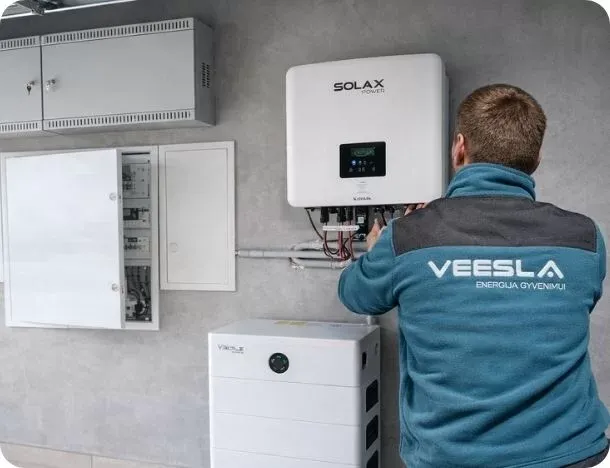
The partnership has brought MarkeDroid’s energy management system (EMS) to Lithuanian customers at a time when the market there is preparing for a change VEESLA has been waiting for for years: the flexibility market in Lithuania is expected to open up to smaller battery owners as well.
According to Urmas Kaarna, MarkeDroid’s sales manager for the Lithuanian market, the cooperation with VEESLA has been exceptionally good, and the partner’s greatest strength is its competence.
“They know our product and service very well. They know how to install it and how to show customers the value of our service,” said Kaarna. “We work very closely together, and questions always get answered quickly.”
In the view of Evaldas Jakubavičius, head of VEESLA Energy, the main strength of MarkeDroid’s platform is its simplicity. “It’s very easy to use, and all the information you need is right there. It takes one second to see how much money the system has saved or what its plan is,” he said.
Most of VEESLA’s customers achieve savings precisely because their sites also have real electricity consumption. “Most of our customers save money because they have consumption on site. In summer they earn revenue from selling, but over the course of the year that money goes towards buying electricity,” Jakubavičius explained.
At the same time, he says, many in the market still believe that the inverter manages the batteries on its own. “Most customers think the inverter takes care of battery management by itself. When you mention EMS and smart battery management, they assume every battery system should work that way anyway,” he noted.
It is exactly this difference – between simple charge-and-discharge logic and control based on market prices and forecasts – that largely determines the profitability of a battery investment.
Before starting to work with MarkeDroid, VEESLA tried out several energy management services. “Based on my experience, I can say that the installation process for MarkeDroid’s EMS is clear, and MarkeDroid has well-defined processes for who handles problems and who handles integrating new systems,” said Jakubavičius.
The flexibility market is expanding in Lithuania
The Lithuanian energy market is undergoing a change that VEESLA has long been waiting for. “Finally, users of smaller batteries should also start earning revenue from trading on the flexibility market. This is the change we have been waiting for,” said Jakubavičius.
In addition, Lithuania currently offers state subsidies to household consumers for installing solar panels, and for installing solar panels together with a battery, for those who can sell up to 1 kW of power to the grid.
Photo: https://veesla.lt/