

Text by Donatas Braziulis, Head of VPP partnerships at MarkeDroid
As the energy transition accelerates, extracting the maximum value from distributed energy resources requires agile trading strategies and robust market access. In June 2026, our collaborative portfolio demonstrated strong operational performance across the Swedish flexibility markets.
This success is built on a powerful synergy: our partner Flower utilizes their advanced trading system and gateway to control the assets and execute bids in the flexibility markets, while MarkeDroid drives the core Energy Management System (EMS) optimization at the site level to ensure the assets are perfectly positioned for those market signals.
Here is a look at our June results, portfolio growth, and how our integrated strategy aligns with industry benchmarks.
Market Participation & Price Dynamics
Currently, the portfolio is live on the mFRR market, actively participating in capacity markets in both directions. Through Flower’s trading infrastructure, the portfolio dynamically bids into either the Up (discharge) or Down (charge) market based on which direction offers the most lucrative revenue opportunity at any given time.
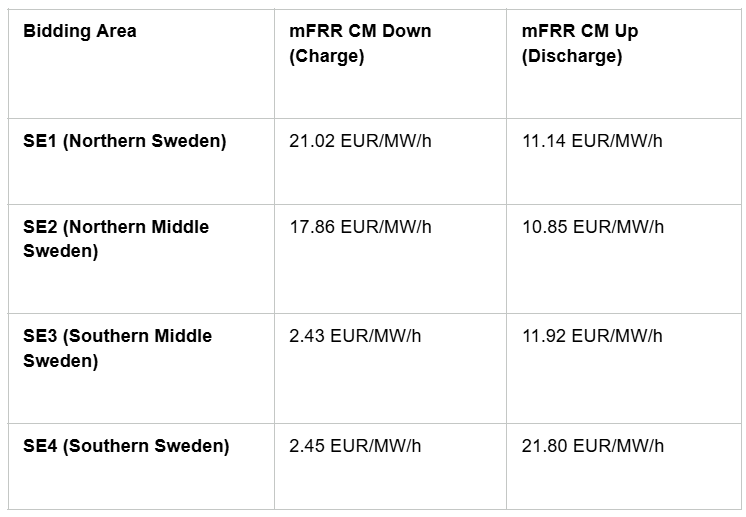
The geographic location of these assets plays a massive role in the overall strategy. As seen in the June 2026 data below, capacity market prices varied significantly across Sweden’s bidding zones:
Average mFRR Capacity Market Prices (June 2026)
The Critical Role of EMS in the Swedish Market
While Flower handles the market access and trading, MarkeDroid’s EMS optimization is the engine that makes this participation possible and profitable.
When a capacity market bid is placed, a corresponding bid is also placed on the energy activation market (EAM). EAM revenue depends not only on the activation price but also on the cost of restoring the battery’s state of charge (SoC)—typically required within an hour after activation. This restoration is done on the intraday market or settled through imbalance, depending on prevailing prices.
In Sweden, where local grid constraints and varying price zones are prevalent, a highly intelligent EMS is vital. MarkeDroid’s EMS ensures that the battery’s SoC is managed flawlessly—restoring energy efficiently to minimize intraday or imbalance costs, while simultaneously protecting the host site’s local energy needs. Without this sophisticated on-site optimization, the trading strategies executed by Flower would not be able to realize their full financial potential.
Fleet Dynamics and Growth
The integration of residential and commercial Battery Energy Storage Systems (BESS) into our Virtual Power Plant (VPP) continues to grow.
- Geographic & Technical Spread: These assets are strategically distributed across Sweden’s SE2, SE3, and SE4 bidding areas.
- Capacity Range: The portfolio utilizes a diverse range of hardware, with system sizes varying from smaller 8 kW and 10 kW residential units up to 30 kW installations.
Strategic Challenges and Portfolio-Level Optimization
Maximizing revenue across a diverse fleet requires high-level orchestration, which occasionally presents unique operational dynamics:
- 1 MW Block Bidding: Market rules dictate that mFRR bids must be placed in 1 MW blocks. Consequently, marginal capacity—particularly from newly onboarded assets—may sometimes fall into the “last 1 MW” that does not clear the market.
- Directional Flexibility Constraints: At the portfolio level, it is often most profitable for Flower to bid exclusively in one direction (such as Up/discharge) while factoring in energy restoration costs. However, because some individual assets are only configured to offer charging or discharging flexibility, they may not generate revenue during periods when the portfolio is optimized for the opposite direction.
Benchmarking Against the Industry
To gauge our market effectiveness, we track the portfolio’s performance against the Clean Horizon Swedish Storage Index.
For June 2026, Clean Horizon reported the following annualized revenue benchmarks for the Swedish market:
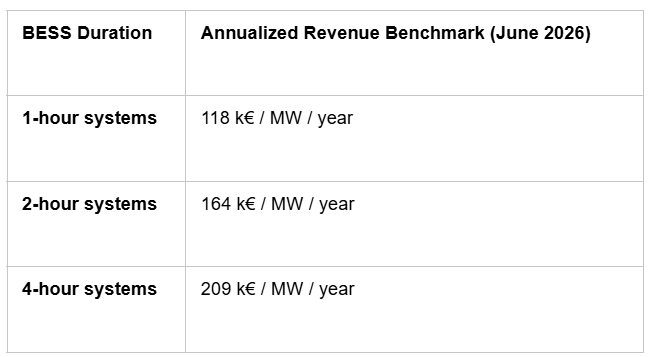
By benchmarking our aggregated portfolio against these indices, we ensure that the combined power of Flower’s trading algorithms and MarkeDroid’s EMS optimization remains highly competitive. Despite the challenges of managing 1 MW blocks and unidirectional asset constraints, our dynamic approach to shifting between Up and Down markets allows us to capture optimal value and deliver strong, consistent returns for our asset owners.
