
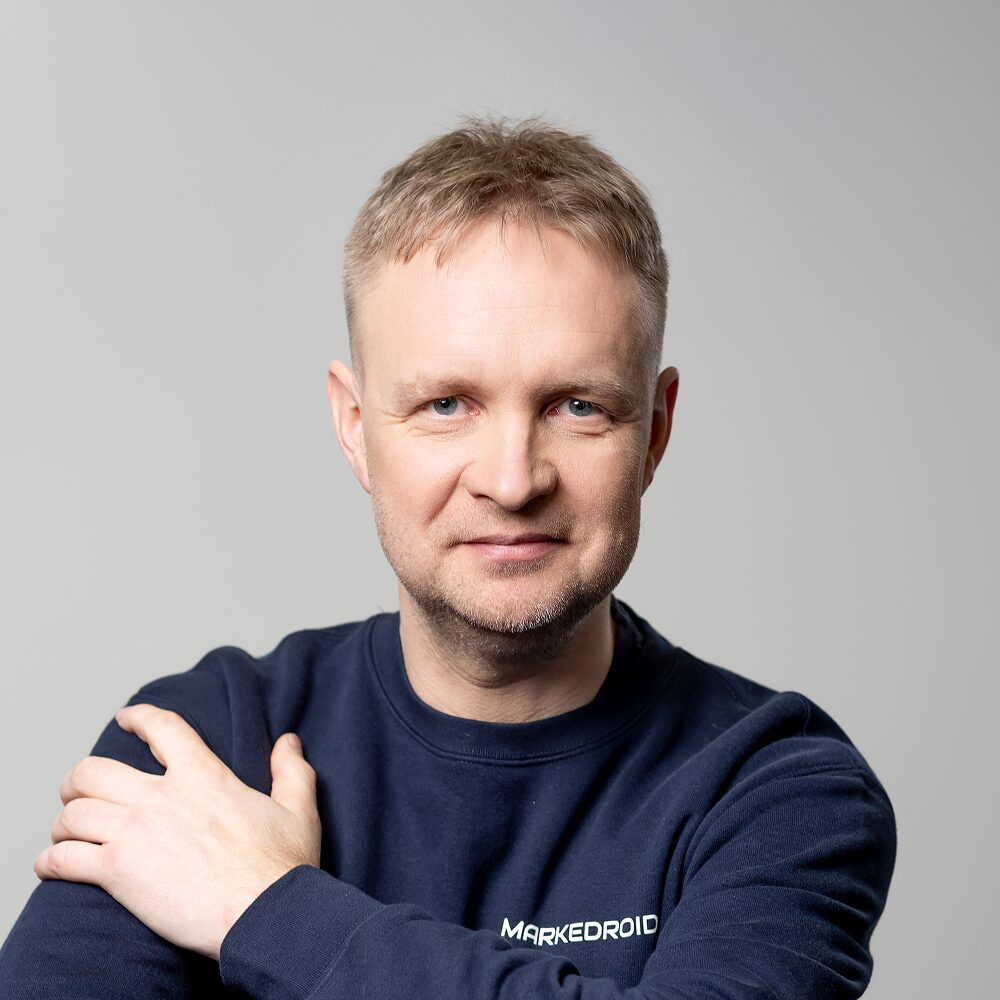
What began in a home garage three years ago has grown into a company of more than 20 people, though the path there has been quite bumpy.
MarkeDroid’s software manages solar panels, battery solutions, self-consumption, and the buying and selling of electricity from the grid at the most favorable price for the owner. The startup began primarily out of the needs of one of the company’s founders, Toomas Kärner, as the electric car added to the family brought electricity bills that were not pleasant to pay. Solving the problem of these bills sparked the company, which celebrated its third anniversary on April 19, 2026.
Many startups fail within the first few years of operation. Why has MarkeDroid survived these difficult early years?
If I had to sum it up in two words: you must have a strong interest and passion for the field in which you operate. Second, a sense of ownership. There is no point in taking on a startup journey without both. Passion drives you to research and understand the field inside and out; a sense of ownership provides the responsibility to do everything that needs to be done. Regardless of the date or time.
It is also important to ask why we should develop such software at all. We remember how involving internet users in creating online content (YouTube, social media, comments sections, TikTok, etc.) fundamentally changed the nature of the internet. For many, it created an opportunity to build their own business in this field; we are aiming for a similar change in the energy landscape. Why? Future energy depends less and less on fossil fuels, and every household or medium-sized business plays a significant role in this sector. For this to happen, several technologies and business models that enable structural changes must work.
Are we talking about the long-discussed energy security here?
Yes. Recent global political events have clearly shown how long supply chains can break instantly and shake entire economies. Energy is the foundation of the entire economy, and its security is a very important cornerstone. The more energy independence a society has, the harder it is to pressure the country through it. Shortening energy supply chains and creating independence is our goal. This can only be done by involving and coordinating a larger number of participants. All goods produced close to us do not contain environmental taxes and are generally cheaper. In other words, independent, local, demand-based, and affordable energy, while involving everyone who is interested, is indeed the goal of our software development.
What was the hardest moment when you thought you would likely have to close the company, if there were any such moments?
There were, indeed. First, perhaps the fact that I had worked for a long time at Telia and also at Eesti Energia, where there was a stable income—which you certainly cannot say about a startup, at least in the beginning. At first, I had the idea that we would do this for six months and everything would work out; after all, I had some savings and we would manage. And six months later, you are in a situation where the savings are gone and your health insurance is about to end—that was a pretty strong breaking point. I remember we discussed at home how to get health insurance because, initially, it was not possible to pay myself a salary. I had never paid much attention to prices in the store, but now I had to do it for quite a while, and, in fact, I still do. I was able to pay myself my first salary a year after starting.
Raising capital is an important topic in startups. How have you managed to get investors on board?
In this field, it’s important how much water is under the keel. I am not a sailor myself, but if there is no water under the keel, the ship can run aground. Yes, we had those moments a year ago where there wasn’t much water. Where you also had to think that if I don’t pay myself a salary, who on the team could I pay? It’s not even about the numbers; you have invited people to join you on a startup journey. They have families at home, children, leases, and they need to go to the grocery store. This has actually been what kept me going in addition—the responsibility for other people.
When did the water come back under the keel, if at all?
About a year ago, when we did an external investment round and Triin Hertmann joined our investors. At the same time, a year had passed for our first satisfied clients, and we were able to extend contracts. We also managed to solve bigger technical challenges by then; I remember times when we sometimes worked with the team until two in the morning. In a startup, the principle must apply that you test all the time. We think about how to do things faster, better, cheaper, and take bigger bites than we can sometimes chew. There have been many rapid changes, and although these are common in the software development field, the hectic environment of a startup adds to it. You have to adapt to all this to survive.
When we look at how rockets are launched into orbit, we know that excess weight is a cost, while too little fuel won’t get you there. Technology must also be strong—it makes no sense to try to accelerate a junker, and an explosion should also be avoided.
What must be done so that the, so to speak, “bang” does not happen when accelerating the rocket?
You have to plan the course. You have to realize that every euro on the company’s account must move you forward. At the moment you have the money, you have to look at how and where to invest it in the startup; you cannot—and must not—just burn it in the engine. For me, MarkeDroid is my first startup, so the learning curve has been immense. This learning curve isn’t even up and down, but has sometimes launched us straight into a wall. And in the end, it is only your own problem how you solve the situations that arise. Of course, there are all kinds of accelerators that help you move forward at that moment, but in the end, you walk this journey with your team. Previous experience in business management and the ability to create a value proposition have helped here. We had to redo the first offer several times when going to clients. So, the learning curve has been steep.
You mentioned earlier that you do not recommend starting a startup if there is no internal burning for the field. What, besides the responsibility to the team, has kept that fire burning?
Perhaps the fact that there are passionate people in the energy sector. In addition to homeowners, our clients are also experienced professionals in their field who develop large solar parks and invest consistently. Many prefer choosing software to manage the parks and letting it work. Also, there is a large number of enthusiasts in the field who figure everything out to the smallest detail. They have many cool ideas, and they also provide thoughts on how to further develop MarkeDroid. Also, the people who are at the beginning of personal energy production are exciting; they need more support, and we can provide it to them. In other words, all these groups keep us on our toes in a good way and keep us moving.
If you had to add keywords to the three years of operation year by year, what would they be?
The first year was clearly a time for getting the company off the ground—reaching paying clients. In the second year, we grew rapidly; we moved to the flexibility market with Fusebox. In the third year, KratTrade was added. In the third year, business clients were also added to our portfolio, and we also started growing the business in other countries, which naturally has its own challenges. The fourth year, which is just beginning, will bring closer cooperation with other participants in the energy landscape to offer an even more comprehensive solution. In other markets, we are aiming for faster growth with the flexibility service. Therefore, I believe that our fourth year will be at least as busy as the first three, and, well, in a year we can make the next summary.
