

According to Andres Pihel, Head of Installation at Solar4You, maintenance is always cheaper than a breakdown. Sander Õispuu, C&I Project Manager at MarkeDroid, adds that without properly working equipment, even smart energy management cannot deliver savings or income for the customer.
Solar4You has been promoting the importance of maintenance for four or five years, but only recently has it become a priority for customers. In the past, problems were dealt with only once they had already occurred, and this often turned out to be very expensive. “Unfortunately, no one has yet invented a product that never needs maintenance,” says Pihel.
One breakdown equals ten years of maintenance fees
Pihel gives the example of an apartment association whose policy was to skip annual maintenance. An inverter only two or three years old broke down because its plug connections had burned out due to lack of maintenance. The repair cost around 2,400 euros.
“Maintenance for a small site costs 150–200 euros. For the price of that repair, the customer could have had 12–14 years of maintenance,” Pihel calculates.
Skipping maintenance can also affect the warranty. If it is proven that a device failed due to lack of maintenance, the manufacturer’s warranty no longer applies. The manufacturer’s own warranty does not cover connections that need to be retightened.
Pihel stresses that modern maintenance does not just mean a technician showing up, tightening a few terminals and sending an invoice. On the alternating current (AC) side, Solar4You takes measurements with the same testers used in electrical installation audits, and on the direct current (DC) side, tests are carried out with specialised testers. The integrity of panels, cables and connections is checked, leakage is measured, and a corresponding report is prepared.
“When we measure every year, we can immediately see if something has deteriorated between two measurements. At one site, the measurement results were very poor, and it turned out that the terminals in Elektrilevi’s connection box had oxidised. Elektrilevi then went to fix the fault,” Pihel describes.
Problems in a solar plant also arise naturally: solar output fluctuates, which heats up cables and terminals, and connections can loosen over time. There is no fixed pattern.
During maintenance, Solar4You has found optimisers that had come loose from the roof, warped panels and panels with broken glass, as well as damaged cables. In one solar park, a stone had hit a panel and shattered its glass, which took down an entire panel string.
“I have examples where several panel strings in a 50 kW plant had been down for years. No one was monitoring the output and the inverter was constantly in alarm. In ground-mounted parks, we have dug new cable lines,” says Pihel. In his experience, insulation leakage is best measured in rainy weather, because everything is wet and faults become apparent.
Maintenance also includes analysing inverter logs, installing software updates and comparing output. Log analysis often reveals overvoltage on the lines, in which case we notify Elektrilevi. Specialised equipment can also measure the performance of solar panels and compare it against the manufacturer’s data and the age of the panels. This makes it possible, for example, to detect a loss of performance where the panel itself still works, but no longer according to the manufacturer’s original specifications.
Whether solar panels need cleaning depends on the location, and a responsible owner should keep an eye on their system themselves – installing bird deterrents if necessary and washing the panels 1–3 times a year with specialised equipment. Various tools for this can be rented through Solar4You.
The whole system must be looked at together
Customers often have a solar plant from one installer and a battery solution from another. During maintenance, Solar4You inspects the entire system, regardless of who installed it, and also maintains plants built by other companies under long-term contracts.
“Every time we go to do maintenance, we find something. With new customers, it often turns out that the installation does not meet the requirements, even though it has passed an audit. Older installations and buildings often also lack double earthing, and this must definitely be checked by specialists,” says Pihel.
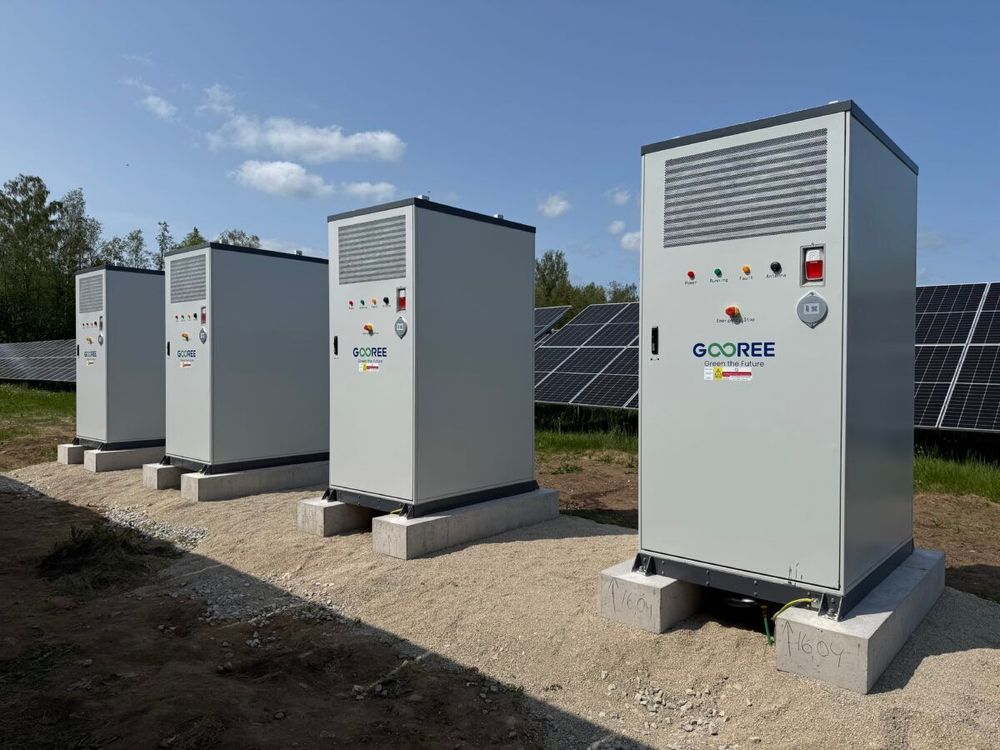
Batteries need special attention, because the Estonian climate sets limits that the manufacturer’s datasheet does not always reflect. Pihel gives the example of a battery that shut itself down in a cold garage at minus 15 degrees, even though its specifications looked good on paper. The battery was successfully revived, but in such a situation you need to act immediately.
“If the supplier says the battery can be installed at temperatures down to minus 20 degrees, it can indeed be discharged in the cold, but it can only be fully charged from plus eight degrees upwards. Practice is a different thing from the datasheet,” Pihel warns.
MarkeDroid’s experience with commercial and industrial customers confirms this. According to Sander Õispuu, battery reliability depends largely on its quality. “With a high-quality battery, maybe one battery in thirty might have an issue over the course of a year. With cheaper batteries, problems occur in every second or third battery within the first six months, and repeatedly,” says Õispuu. According to him, the internal management of cheap batteries is often inadequate, and if a battery keeps shutting itself down, it just sits idle and generates costs instead of income.
Maintenance is a prerequisite for smart management
Solar4You works together with MarkeDroid, whose software manages solar plants and batteries based on the electricity price. Maintenance is essential for MarkeDroid as well: if the inverter does not respond or the communication link is down, the plant cannot be controlled.
“Our planner and control software work best when the core components – load, solar, battery and grid connection – are fully readable. If the data is incomplete or partial, our results are not as accurate as they could be,” explains Õispuu.
According to him, MarkeDroid is responsible for control-related issues, but if a battery suddenly stops responding after months of operation, it is worth starting with the device itself. “You need to check whether the battery has an active fault, whether anything in the hardware has burned out, and whether the equipment has been maintained. Unfortunately, people often come to us with these questions, even though we did not select or install the solution. In that case, you need to contact the installation partner,” says Õispuu.
To find problems faster, the MarkeDroid platform offers partners a diagnostic view that, regardless of the manufacturer, displays battery data that cannot even be seen on the manufacturer’s own platform. “If the battery temperature is too low or the connection is down, the system helps determine whether it is a power outage, a tripped fuse or a communication failure. Then the end customer or the installer knows how to respond,” says Õispuu.
Pihel confirms that communication problems are often caused by everyday changes. “Today we had a site where the owner had replaced the network equipment and lost the connection to the batteries. There was no network cable in the garage and Wi-Fi didn’t work,” he describes. For critical sites with large battery systems, Solar4You has built redundant communication solutions so that the system stays operational even if one connection fails.
Solar4You reminds its customers about the need for maintenance, but the final decision rests with the customer. “Everyone is responsible for their own plant. But those who have learned from their mistakes have started maintaining their equipment, and that’s something to be glad about,” Pihel concludes.
Read more: https://solar4you.ee/?lang=en&s4y_view=maintenance
Photo Credit: Solar4You